
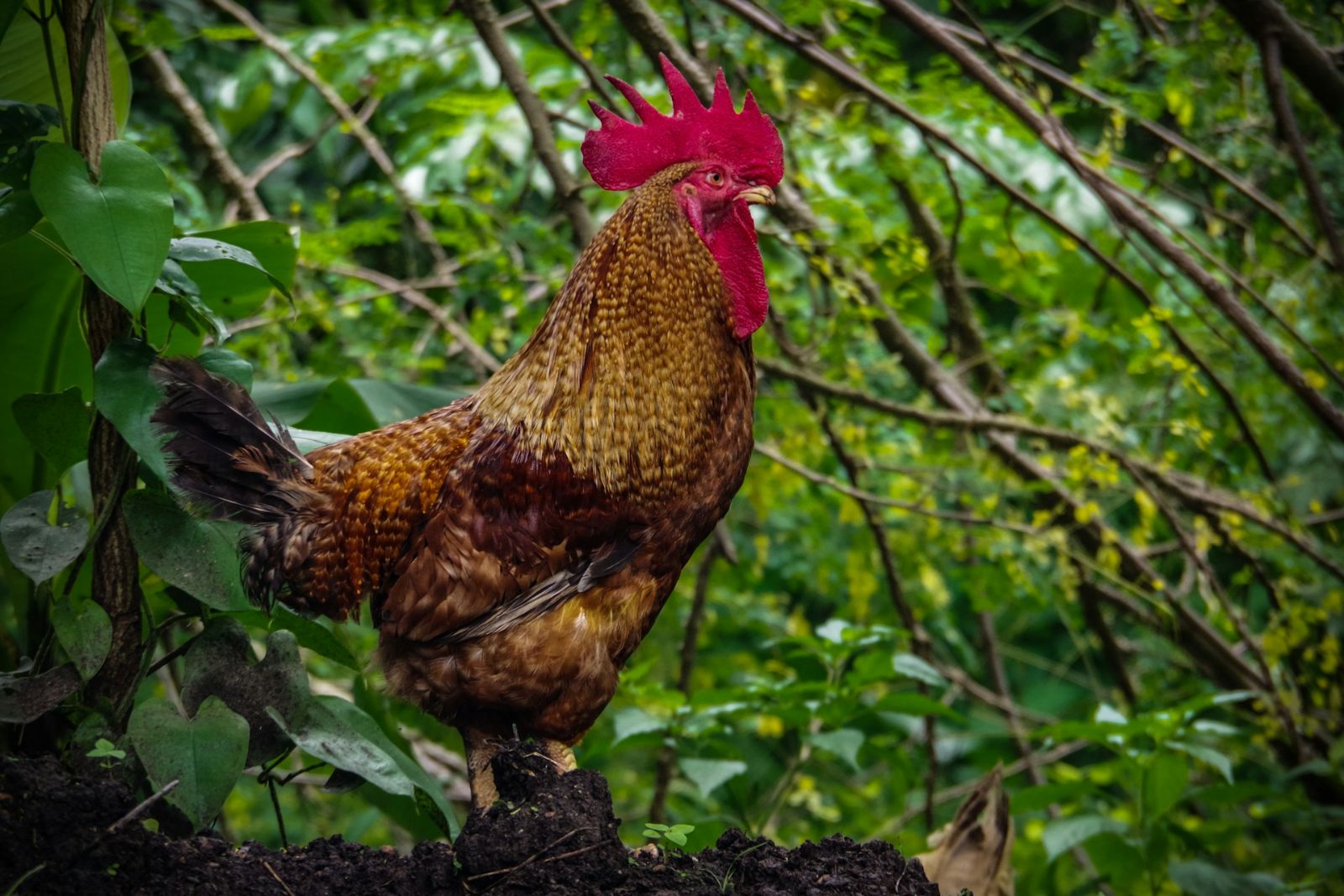
The origin of our domestic chicken breeds stretches back thousands of years, and the story of how our chickens became some of humankind’s most reliable companions and food source spans several continents. In this article, we explore the rich history of our feathered friends, from their wild ancestors to the diverse breeds pecking around in coops around the world today.
All to answer this one important question: “What came first, the chicken or the egg?”
The Ancient Roots of Modern Chickens
Chickens belong to the order Galliformes, also known as gamebirds, which includes about 290 species worldwide. These heavy-bodied ground birds share several characteristics: they’re generally poor flyers but excellent runners, have strong feet for scratching, and most nest on the ground.
The Galliformes family tree branches into several subfamilies. Chickens belong to the Phasianidae family, which includes pheasants, partridges, and peacocks. This family emerged around 30 million years ago in Asia, developing from ground-dwelling birds that had adapted to life in dense forests and grasslands. These early ancestors developed strong legs for scratching and running, specialized digestive systems for processing seeds and insects, and complex social behaviors that would later prove crucial for domestication.
The Wild Ancestors: Junglefowl
The primary ancestor of domestic chickens is the Red Junglefowl (Gallus gallus), a bird that still roams free in the forests of Southeast Asia. These birds perfectly demonstrate the midpoint between wild gamebirds and domestic chickens. Male Red Junglefowl sport the familiar red combs and wattles seen in modern roosters, along with spectacular red, orange, and green plumage. Females are more subtly colored in browns and tans, providing camouflage while nesting.
Three other junglefowl species contributed to domestic chicken genetics:
- The Grey Junglefowl (Gallus sonneratii) of southern India added several important traits to domestic chickens, including the yellow skin found in many modern breeds. These birds are distinguished by their grey coloring and peculiar spotted neck feathers.
- The Green Junglefowl (Gallus varius) of Indonesia contributed some color variations found in our domesticated breeds. These striking birds have dark green-black plumage and unique purple wattles.
- The Sri Lankan Junglefowl (Gallus lafayettii) likely made minor contributions to domestic chicken genetics, though its exact influence remains debated among scientists.
The Path to Domestication
Recent genetic and archaeological studies have revealed that chicken domestication was more complex than previously thought. Rather than a single event, domestication occurred multiple times across different regions of Asia, beginning around 8,000 years ago.
The earliest known domestic chicken remains were found in northern China, dating to around 6000 BCE. However, simultaneous domestication was likely occurring in India and Southeast Asia. Each region selected for slightly different traits, leading to distinct early varieties:
In China, early domestication focused on birds for cockfighting and religious ceremonies. Chinese breeds developed distinctive features like feathered legs and black bones, still seen in breeds like the Silkie.
In India, domestication may have initially focused on the birds’ religious significance. The region developed breeds known for their aggressive temperament, which later influenced many fighting breeds.
Southeast Asian domestication appears to have emphasized practical traits like meat and egg production. Many of today’s most productive breeds trace their ancestry to this region.
The Spread of Chickens Across Ancient Civilizations
From these centers of domestication, chickens began their journey around the world. The spread of chickens closely followed human trade routes and migrations:
By 2000 BCE, chickens had reached the Indus Valley civilization, where they were depicted in art and mentioned in early texts. The region developed several distinct breeds adapted to local conditions.
Around 1500 BCE, chickens arrived in Egypt through maritime trade routes. Egyptian artificial incubation techniques, developed around 300 BCE, could produce 10,000 chicks per month in specialized mud-brick hatcheries.
The Phoenicians, master traders of the ancient world, brought chickens to their colonies across the Mediterranean between 1200-800 BCE. Their trading networks helped establish chicken keeping throughout the region.
By 800 BCE, chickens had reached Greece, where they gained religious significance. Greek red-figure pottery often depicted roosters, and chicken keeping became widespread throughout Greek colonies.
Roman expansion spread chickens across Europe from 500 BCE onwards. Romans developed practical guides for chicken keeping and established domesticated chicken breeds suited to different regions of their empire.
Polynesian settlers carried chickens across the Pacific Ocean between 800-1200 CE, reaching remote islands like Easter Island. These migrations show how easily chickens were able to adapt to different environments.
The Journey to the Americas
Chickens reached the Americas through multiple routes. Archaeological evidence suggests that Polynesian voyagers may have brought chickens to South America’s western coast as early as 1200 CE, though this remains debated among researchers.
The more widely documented arrival came with European colonization. Christopher Columbus brought chickens on his second voyage to the Americas in 1493. Spanish conquistadors and settlers then spread chickens throughout Central and South America.
In North America, chickens arrived with the earliest European settlements. The Jamestown colony received chickens from supply ships in 1607, and by 1623, the Plymouth colony was actively breeding them. Native American tribes quickly recognized the value of these birds and incorporated them into their agricultural practices.
By the early 1800s, chicken keeping had become widespread across North America. The development of American breeds began in earnest, with farmers selecting birds suited to local conditions. The creation of distinctly American breeds like the Rhode Island Red, Plymouth Rock, and New Hampshire demonstrated the growing sophistication of American poultry breeding.
The Age of Breeds: Medieval to Modern Times
The medieval period saw the development of distinct regional chicken varieties across Europe and Asia. Monasteries played a crucial role, maintaining careful breeding records and developing productive egg-laying strains.
The explosion in chicken breed development really began during the Victorian era (1837-1901). This period saw several key developments:
- The Hen Fever of the 1850s swept Britain and America, creating unprecedented interest in exotic chicken breeds. Asian breeds like the Cochin sparked this craze, introducing new traits like feathered legs and extreme docility.
- The establishment of poultry societies and breed standards helped preserve distinct varieties. The American Poultry Association‘s Standard of Perfection, first published in 1874, set specific criteria for each breed.
- Scientific breeding programs emerged, focusing on practical traits like egg production and growth rate. This led to today’s highly productive commercial strains.
The Extended Family: Related Birds in Modern Times
The chicken’s closest living relatives help us understand their evolution and natural behaviors. Pheasants, which share a recent common ancestor with chickens, demonstrate what early chicken ancestors might have looked like. The Ring-necked Pheasant shows many behavioral similarities to chickens, from dust bathing to scratching for food.
Peacocks represent another fascinating branch of the family. While modern chickens were bred for practicality, their cousins the peafowl developed spectacular display feathers. Despite their different appearances, peacocks and chickens share many basic behaviors and can even cross-breed in rare cases.
Guinea fowl, originally from Africa, offer another interesting comparison. Though domesticated, they’ve retained more wild characteristics than chickens. Their speckled feathers provide excellent camouflage, and they maintain strong flocking instincts – traits that were likely common in early domestic chickens as well.
Modern Heritage and Conservation
Today’s chicken breeds represent this rich historical legacy. Heritage breeds preserve genetic diversity and historical traits that might otherwise be lost. These traditional varieties maintain natural behaviors that make them excellent foragers and attentive mothers – traits particularly valuable for backyard chicken keeping.
Understanding this long history helps explain many chicken behaviors. When your chickens scratch in the dirt, they’re displaying the same foraging instincts their junglefowl ancestors used. Their tendency to seek elevated roosts at night reflects their wild ancestors’ habit of sleeping in trees for safety.
Modern backyard chickens represent thousands of years of history, carrying genetic traces of their wild ancestors while embodying centuries of careful breeding. These remarkable birds continue to adapt and thrive, bringing their ancient heritage right into your backyard.


0 Comments